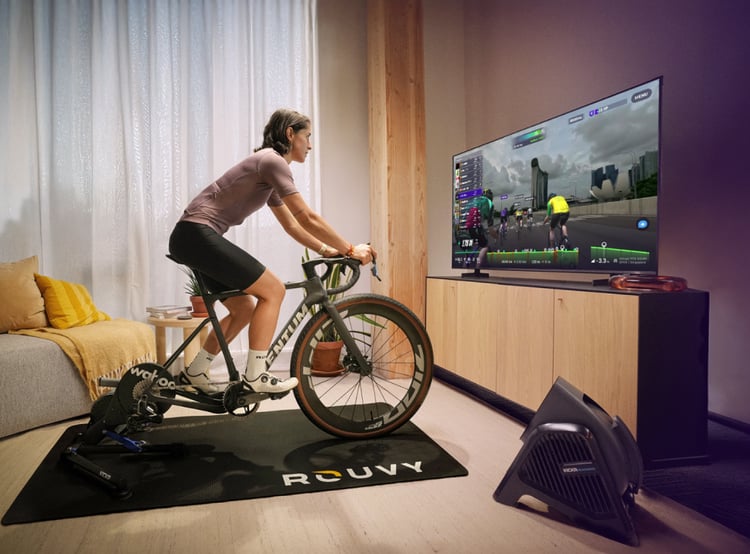
Choosing the best indoor cycling apps used to be simple because there was essentially one serious option. That is no longer true. The indoor training market has matured into a genuinely competitive field, and the platform you ride on now shapes your fitness as much as the trainer underneath your bike. As a coach who has spent the last decade prescribing winter blocks for World Tour professionals and time-crunched amateurs alike, I can tell you that the "best" app is not the one with the flashiest graphics or the largest user base. It is the one that matches the way you actually train, the goals you are chasing, and the hours you realistically have.
This guide compares the six platforms I recommend most often, with honest pros and cons, current pricing, and specific use-case recommendations. No marketing gloss, no padding. By the end you will know exactly which app deserves your subscription this season.
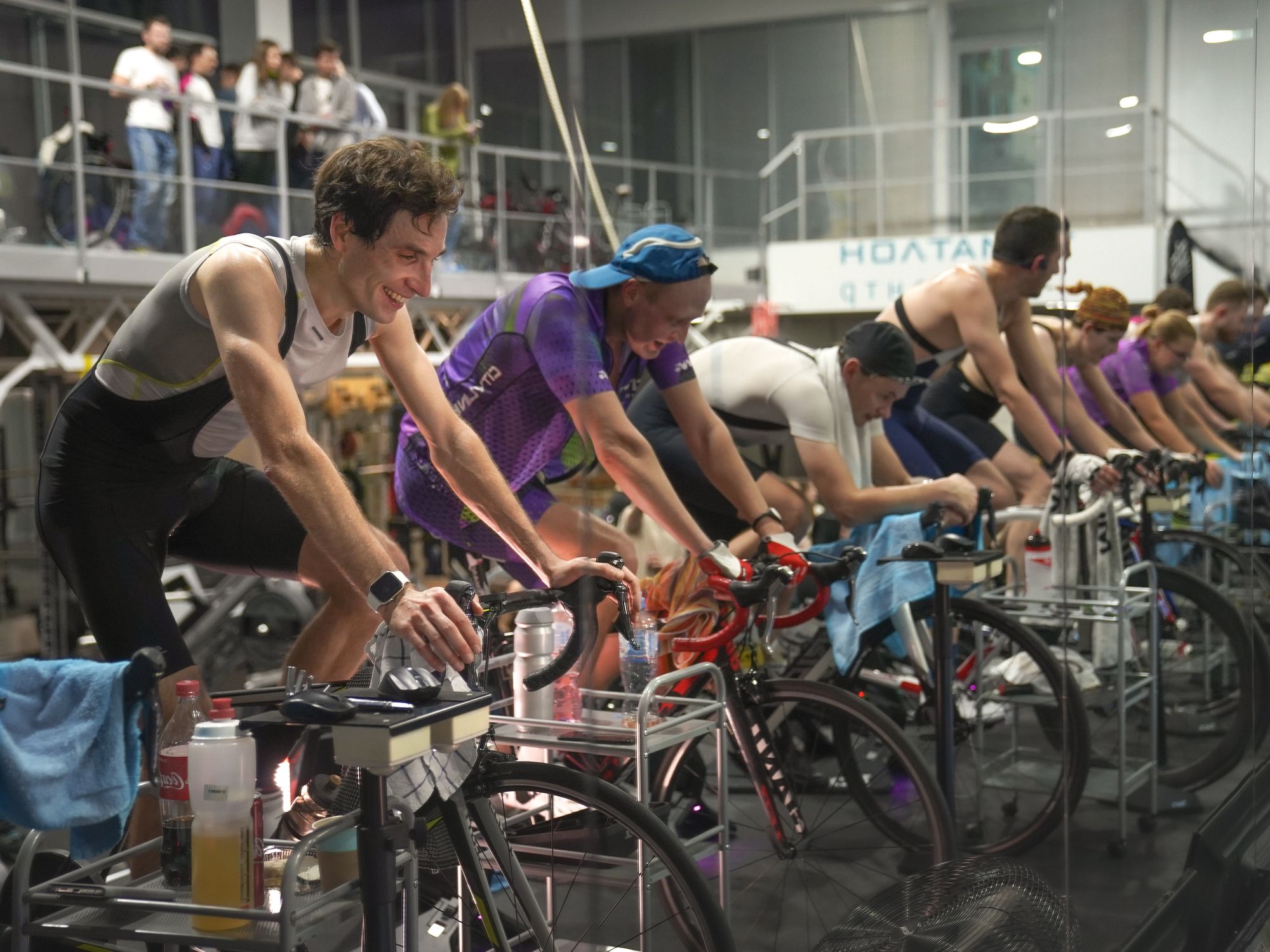
What actually separates the best indoor cycling apps
Before naming names, understand what you are paying for. Every modern indoor cycling app does three things: it talks to your smart trainer, it gives you something to look at, and it records your data. The differences live in the philosophy behind each one.
Broadly, the platforms split into two camps. Virtual-world apps like Zwift and Rouvy prioritise immersion and motivation. They put you in a game-like environment, surround you with other riders, and make the time pass. Structured-training apps like TrainerRoad and Wahoo SYSTM prioritise physiological adaptation. They build a plan around your numbers, adjust it as you improve, and care far less about whether you are entertained.
Neither philosophy is superior in the abstract. The motivation an immersive app provides is worthless if its workouts are unstructured, but the most perfectly periodised plan in the world fails if you cannot bring yourself to clip in. The skill is matching the tool to your temperament and your calendar.
The metrics that drive every platform
Whichever app you choose, three numbers underpin everything it asks of you: functional threshold power, power zones, and heart rate zones. Your FTP anchors the intensity of every structured workout, your power zones translate that single number into the targets you actually ride, and your heart rate zones provide a physiological cross-check on the days your legs and your power meter disagree.
If you have never formally tested these, sort that out before you subscribe to anything. Use our FTP calculator to establish your threshold, then map your training intensities with the power zones calculator and the heart rate zones calculator. An app is only as smart as the data you feed it, and a wrong FTP makes even the best platform prescribe the wrong work.
The best indoor cycling apps in 2026, reviewed
Here are the six platforms worth your money this year, each evaluated on what it does well, where it falls short, what it costs, and who it suits.
1. Zwift — best for motivation and group riding
Zwift remains the default for a reason. It pioneered the virtual-world category and still owns it, dropping you into rendered landscapes from London to a fictional island called Watopia, surrounded by thousands of real riders climbing, sprinting, and racing in real time. For a large segment of cyclists, the social pull is the single thing that gets them on the trainer in January.
Its racing scene is genuinely competitive, with structured categories, sanctioned events, and a level of organisation that no rival matches. The workout mode and training plans have improved markedly and are now perfectly adequate for building fitness, even if structure is not the platform's primary identity.
The weaknesses are the flip side of its strengths. Zwift demands the most capable hardware of any app here, and on an older laptop or basic device the graphics suffer. Riders chasing tightly periodised progression will find the training library shallower than a dedicated coaching app. And the gamified economy of unlockable frames and wheels feels gratuitous to some.
Pros: unmatched community and racing, strong motivation, polished experience, huge user base.
Cons: hardware-hungry, training structure secondary, in-game progression can distract.
Price: $19.99/month or $199.99/year.
Best for: riders who need other people to stay motivated and want to race indoors. Explore it at zwift.com.
2. TrainerRoad — best for structured improvement
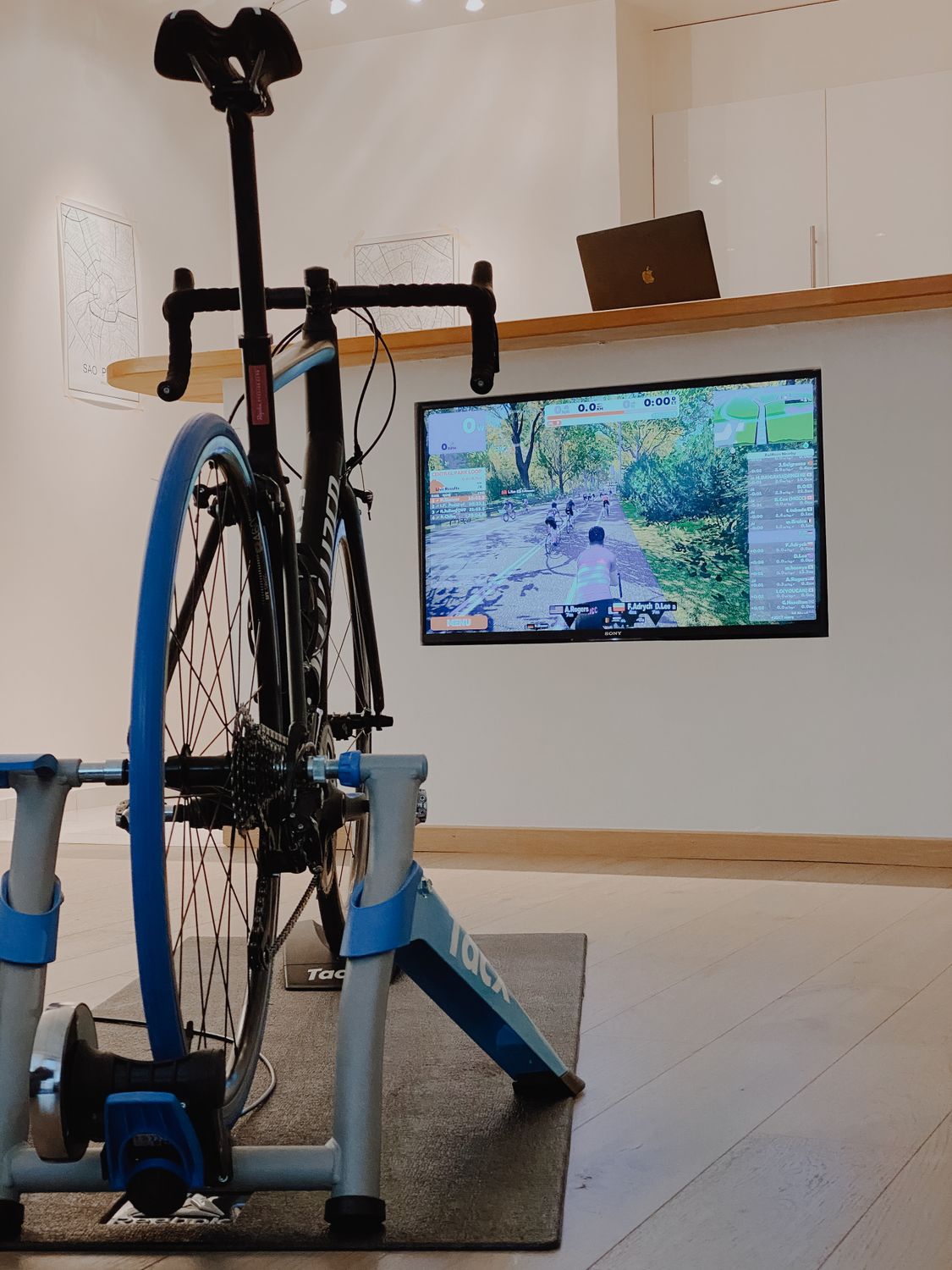
If your only goal is to get faster, TrainerRoad is the most ruthlessly effective tool on this list. It strips away the scenery and the avatars and focuses entirely on the work that produces adaptation. Its standout feature, Adaptive Training, uses machine learning to adjust your plan automatically based on how you perform in each session, raising or lowering future intensity so you are always training at the edge of what you can absorb.
The workout catalogue is enormous and meticulously categorised by progression level, so the platform always knows whether a given interval set is a stretch or a gimme for your current fitness. Its plan builder asks for your event date and discipline and constructs a full periodised block around it. For a self-coached athlete who wants the rigour of a coaching system without the cost, nothing else comes close.
The trade-off is engagement. Staring at a graph of coloured power bars for ninety minutes is, for many people, a test of will. There is now an optional virtual-riding mode, but immersion is not why anyone chooses this app. You choose it because it works.
Pros: best-in-class structure, Adaptive Training, vast workout library, excellent plan builder.
Cons: visually spartan, limited social element, requires discipline.
Price: $21.99/month or $209.99/year.
Best for: goal-driven riders training for an event who value results over entertainment. See trainerroad.com.
3. Wahoo SYSTM — best for all-round periodised training
Wahoo SYSTM, built on the foundations of the old Sufferfest, is the most complete training ecosystem here. Its signature is the Four-Dimensional Power test, which profiles not just your threshold but your neuromuscular sprint, anaerobic capacity, and maximal aerobic power, then tailors every workout to your individual strengths and weaknesses. Two riders with identical FTPs can receive meaningfully different targets, which is exactly how a good coach would treat them.
SYSTM also goes well beyond the bike. Subscriptions include yoga, strength training, and mental-toughness sessions, plus famously brutal video workouts set to professional race footage. For an athlete who wants their whole physical preparation under one roof, it is superb value.
The downside is that the on-bike visuals are video footage rather than a live virtual world, so there is no real-time interaction with other riders. If community is your motivator, this is not your app.
Pros: 4DP individualised profiling, included strength and yoga, immersive video workouts, strong value.
Cons: no live multiplayer world, interface less slick than rivals.
Price: $17.99/month (annual billing available at a discount).
Best for: riders who want a single platform covering on-bike and off-bike preparation with individualised targets.
4. Rouvy — best for real-world routes
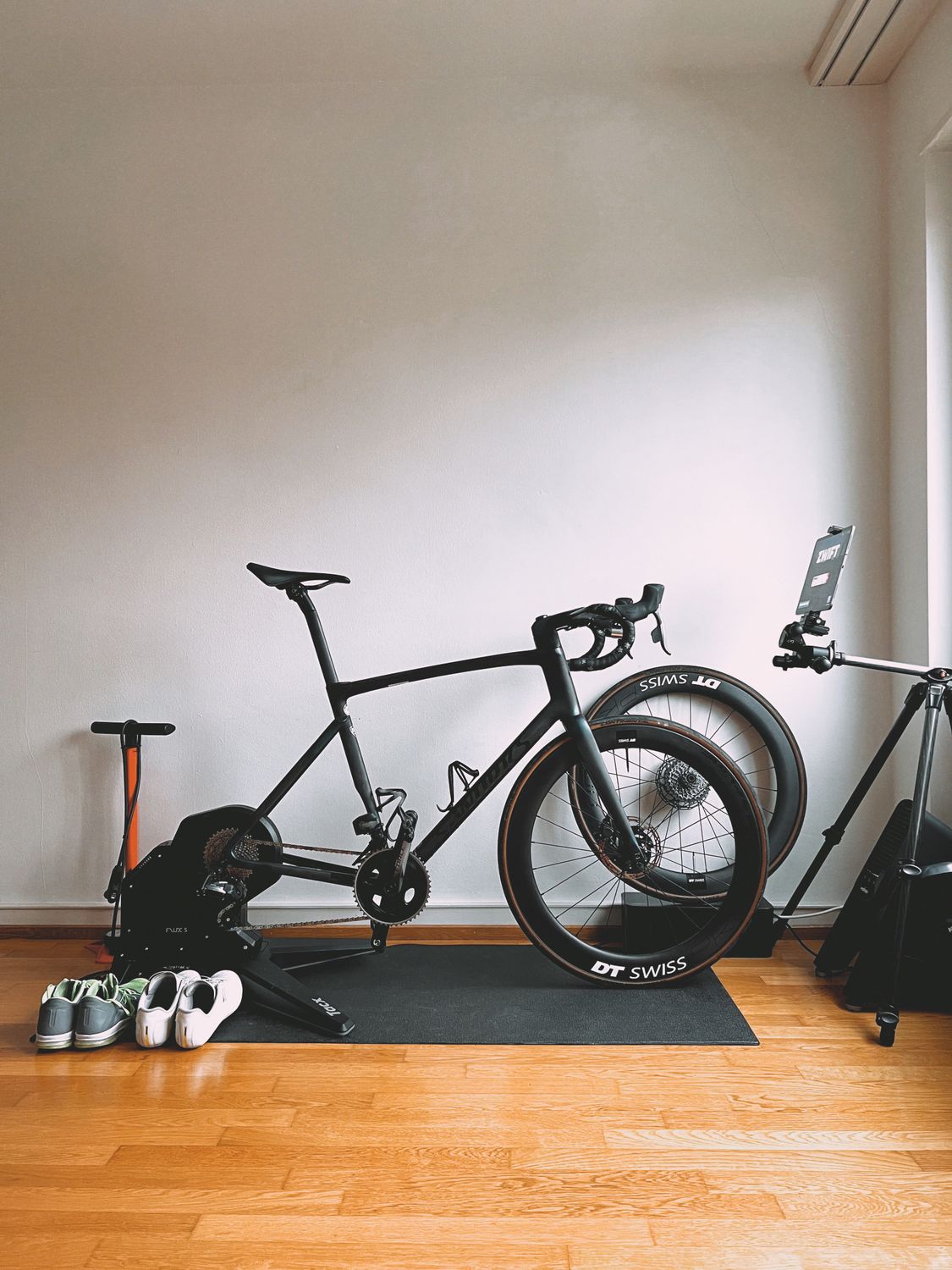
Rouvy occupies a clever niche between the cartoon worlds of Zwift and the graph-based austerity of TrainerRoad. Instead of rendered landscapes, it overlays your avatar onto actual video footage of real roads using augmented reality, with a library of over 1,500 routes including Ironman courses and Grand Tour stages. If you want to preview the exact climb you will race in three months, Rouvy lets you ride it from your spare room.
The realism is its calling card. Pedalling up a filmed alpine pass, with the gradient changing under your wheels in sync with the video, is a genuinely different experience from a gamified climb. It also supports structured workouts and group events, making it a credible all-rounder.
Its community is smaller than Zwift's, so spontaneous group rides can feel quieter, and the AR blending occasionally shows its seams. But for route-specific preparation it is unmatched.
Pros: realistic AR routes, excellent for course recon, supports structured sessions.
Cons: smaller community, occasional visual artefacts.
Price: $19.99/month.
Best for: riders preparing for a specific real-world event who want to rehearse the actual terrain.
5. MyWhoosh — best free option
MyWhoosh has changed the economics of indoor training. Developed in the UAE, it offers a full virtual-world experience, structured workouts, and competitive racing with no subscription fee whatsoever. There is no trial period and no freemium tier holding the good features hostage; the entire platform is free, and the company has publicly committed to keeping it that way.
The quality has risen sharply. The graphics are now genuinely competitive with the paid leaders, the racing has attracted strong fields, and the workout structure is solid. For a rider unwilling to pay a monthly fee, or anyone wanting to test whether indoor training suits them before committing, it is the obvious starting point.
Caveats apply. The route catalogue and community, while growing fast, do not yet match the established platforms, and the long-term feature roadmap depends on continued backing. But as a free offering it is remarkable, and it has forced every paid rival to justify its price.
Pros: completely free, strong graphics, real racing, structured workouts.
Cons: smaller route library, community still maturing.
Price: free.
Best for: budget-conscious riders and newcomers testing the waters before paying for anything.

6. FulGaz — best for immersive 4K scenery
FulGaz is the connoisseur's choice for filmed-route riding. Its footage is shot in high resolution along some of the most beautiful and iconic roads in cycling, and on a large screen the effect is closer to a documentary than a video game. Gradient and resistance sync precisely to the terrain, so the ride feels honest.
It is less about racing and community and more about a high-quality solo experience, ideal for steady endurance rides where you want to be absorbed rather than entertained by competition. It also supports structured workouts layered over the scenery.
The library leans toward scenic riding rather than head-to-head competition, so committed racers will look elsewhere. But for endurance and recovery work that does not feel like a chore, it is hard to beat.
Pros: stunning real-world 4K footage, accurate gradient simulation, calming solo experience.
Cons: limited racing and social features, smaller user base.
Price: around $15/month, with a free tier available.
Best for: riders who want immersive, scenic endurance sessions over competition.
How to choose the right app for you
Strip away the feature lists and the decision comes down to three honest questions about yourself.
What motivates you to start the session? If the answer is other people and competition, choose Zwift or MyWhoosh. If it is seeing concrete fitness gains, choose TrainerRoad or Wahoo SYSTM. If it is beautiful roads and escapism, choose Rouvy or FulGaz. Be ruthlessly honest here, because the best plan you never execute is worthless.
What are you training for? A specific event with a known course points toward Rouvy for terrain rehearsal. A general "get faster" goal points toward TrainerRoad. A desire to improve as a complete athlete, including strength and mobility, points toward Wahoo SYSTM.
What is your budget? If the answer is zero, MyWhoosh is genuinely good enough that money is no longer an excuse. If you will pay for the right fit, the $15 to $22 monthly range buys real value across the board.
Many serious riders run two apps: a structured platform for the prescribed work and a virtual world for the days they simply need to turn the pedals without thinking. There is no rule against it, and the combination often delivers the best of both philosophies.
How to actually train indoors: a sample week
Owning the best app means nothing without a sensible structure to run on it. Indoor training's great advantage is density: with no coasting, no traffic lights, and no descents, an hour on the trainer delivers far more usable stimulus than an hour on the road. Research on high-intensity interval training consistently shows that short, structured indoor sessions produce significant gains in maximal oxygen uptake and threshold power, which is why time-crunched athletes often improve faster in winter than in summer (Milanović et al., 2015, Sports Medicine).
Here is a balanced week that any of these apps can deliver, assuming roughly five hours available:
- Monday — rest or mobility. Recovery is where adaptation happens. If using Wahoo SYSTM, slot in a yoga session.
- Tuesday — VO2 max intervals. Five to six efforts of three minutes at 110–120% of FTP, with equal recovery. This is the highest-return session of the week.
- Wednesday — Zone 2 endurance. Sixty to ninety minutes steady in the aerobic zone. Ideal for a scenic Rouvy or FulGaz route that keeps you honest at a low intensity.
- Thursday — threshold work. Two to three blocks of ten to twenty minutes at 95–105% of FTP. The bread and butter of raising your sustainable power.
- Friday — rest.
- Saturday — long endurance or a group ride. Two hours, or a Zwift race if you want to test your form against others.
- Sunday — easy spin or off. Optional Zone 1 recovery to flush the legs.
Note how the hard days are genuinely hard and the easy days are genuinely easy. The most common mistake I see in self-coached indoor riders is letting every session drift into a grey middle zone, hard enough to cause fatigue but not hard enough to drive top-end adaptation. The apps will hold you to the targets if you let them, but only if your FTP is set correctly in the first place.
Getting the most from any indoor cycling app
A few practical points separate riders who thrive indoors from those who quietly abandon the trainer by February.
Manage your environment. Indoors you lose the cooling effect of moving air, and overheating will tank your power within minutes. A powerful fan is not a luxury; it is performance equipment. Keep the room cool, hydrate more than you think you need, and the same intervals will feel dramatically easier.
Retest regularly. Your FTP will climb on a good block, and a stale number means the app is prescribing efforts that are too soft. Retest every four to six weeks and update your zones so the platform keeps pace with your fitness.
Calibrate your trainer. A smart trainer that has drifted out of calibration reports inaccurate power, corrupting every workout and every comparison. Follow the manufacturer's spin-down procedure regularly, and let the trainer warm up before hard efforts.
Respect recovery. The efficiency of indoor training is a double-edged sword. Because every minute counts, it is easy to accumulate fatigue faster than you would outdoors. Build genuine rest into the week and watch for the signs of overreaching.
Do you need a smart trainer to use these apps?
This is the question I am asked most often, and the honest answer is: not strictly, but it changes the experience profoundly. Every app on this list will work with a basic setup using a speed sensor or a power meter on a "dumb" trainer, displaying your effort and recording your data. What you lose without a smart trainer is automatic resistance control.
A smart trainer adjusts its resistance electronically in two ways. In ERG mode, the trainer locks you to a target wattage regardless of your gear or cadence, so a structured workout simply holds you at, say, 250 watts while you concentrate on pedalling. In simulation mode, it varies resistance to match the gradient of a virtual climb, so a 10% pitch in Watopia actually feels like climbing. Both transform the realism and the precision of indoor training.
If you are serious about structured work, the ERG-mode benefit alone justifies the investment, because it removes every excuse to ease off mid-interval. The trainer simply will not let you. For riders on a budget, pairing a power meter with MyWhoosh is a capable entry point, but upgrading to a smart trainer is the single biggest hardware improvement you can make to your indoor setup.
Frequently asked questions
Can I switch apps without losing my training history?
Largely, yes. Almost every platform here syncs completed activities to third-party services such as Strava and TrainingPeaks, so your historical record lives independently of any single app. Your FTP and zones travel with you too, since they are simply numbers you re-enter. You can trial several apps over a few months without losing the thread of your progression.
Is indoor training really as effective as riding outside?
For building fitness, indoor training is often more effective per hour because of its density and control. There is no freewheeling, no waiting at junctions, and no soft-pedalling on descents, so the proportion of your session spent producing meaningful stimulus is far higher. What you miss outdoors is bike-handling, pack skills, and the specific demands of real terrain, which is why most riders blend the two rather than choosing one exclusively.
How long should an indoor session be?
Shorter than you think. Because of the higher intensity density, a focused 45 to 60 minute indoor workout frequently delivers more than a two-hour outdoor ride. Only your long endurance sessions need to stretch beyond 90 minutes, and even those are best capped at what you can complete with good form and adequate cooling.
The bottom line
There is no single best indoor cycling app, only the best app for your motivation, your goals, and your budget. Zwift owns community and racing. TrainerRoad owns structured improvement. Wahoo SYSTM owns all-round periodised preparation. Rouvy owns real-world route rehearsal. MyWhoosh owns the free tier outright. FulGaz owns scenic immersion. Choose the one whose strength matches the reason you will actually clip in, set your zones accurately, and the platform becomes one of the most powerful training tools you own.
An app gives you the environment and the workouts, but it cannot tell you whether you are doing the right work at the right time for your particular goals, nor can it adjust your season when life intervenes. That judgement is what a coach provides. If you want a plan built around your physiology, your calendar, and your target events rather than a generic template, explore our tailored training plans or apply for one-to-one coaching. The best app in the world still benefits from an expert deciding what to put on it.