A VO2 max test is the single most direct way to measure your aerobic engine — the maximum rate at which your body can take in oxygen, transport it, and burn it to produce power on the bike. Every coach I've worked with at the WorldTour level treats it as a foundational number, but most amateur cyclists either misunderstand what it measures or test it badly enough that the result is meaningless. This guide fixes both problems. You'll learn exactly what a VO2 max test measures, how the lab version works, how to run a valid field test at home, what your number actually means against real benchmarks, and how to turn the result into training that moves the needle.
I've supervised hundreds of these tests on riders ranging from first-season amateurs to Grand Tour stage winners. The protocol matters more than the equipment, and interpretation matters more than the protocol. Let's get all three right.
What Is VO2 Max?
VO2 max is your maximal rate of oxygen uptake, expressed in millilitres of oxygen consumed per kilogram of body weight per minute (ml/kg/min). It represents the ceiling of your aerobic metabolism — the most oxygen your muscles can actually use to resynthesise ATP when you're working as hard as you physiologically can.
The reason it correlates so strongly with endurance performance comes down to the Fick equation: VO2 = cardiac output × arteriovenous oxygen difference. In plain terms, your VO2 max is the product of how much blood your heart can pump per minute (stroke volume × heart rate) and how much oxygen your working muscles can extract from that blood. Train either side of that equation — a bigger stroke volume, more capillaries, more mitochondria, higher blood volume — and your VO2 max rises.
It's worth being precise about what VO2 max is not. It is not your FTP, it is not your lactate threshold, and it is not a complete predictor of race results. Two riders with an identical VO2 max can have very different threshold powers depending on how high a fraction of that ceiling they can sustain. VO2 max sets the size of the engine; threshold and efficiency determine how much of that engine you can use over a given duration. That's exactly why this test belongs alongside, not instead of, threshold testing.
Why VO2 Max Matters for Cyclists
Three reasons. First, it's a hard physiological ceiling for short, intense efforts — the 3-to-8-minute climbs and attacks that decide races are run largely at or above VO2 max power. Second, it's a benchmark of trainability: tracking it over a season tells you whether your aerobic base work is producing real central adaptations or whether you've plateaued. Third, when expressed relative to body mass it predicts climbing performance better than almost any other lab value. A rider at 75 ml/kg/min has roughly twice the aerobic headroom of a recreational rider at 38, and on a 20-minute climb that gap is decisive.
How a VO2 Max Test Works in the Lab
The laboratory VO2 max test — often called a graded exercise test (GXT), incremental test, or cardiopulmonary exercise test (CPET) — is the gold standard. Here's what actually happens when you walk into a properly run lab.
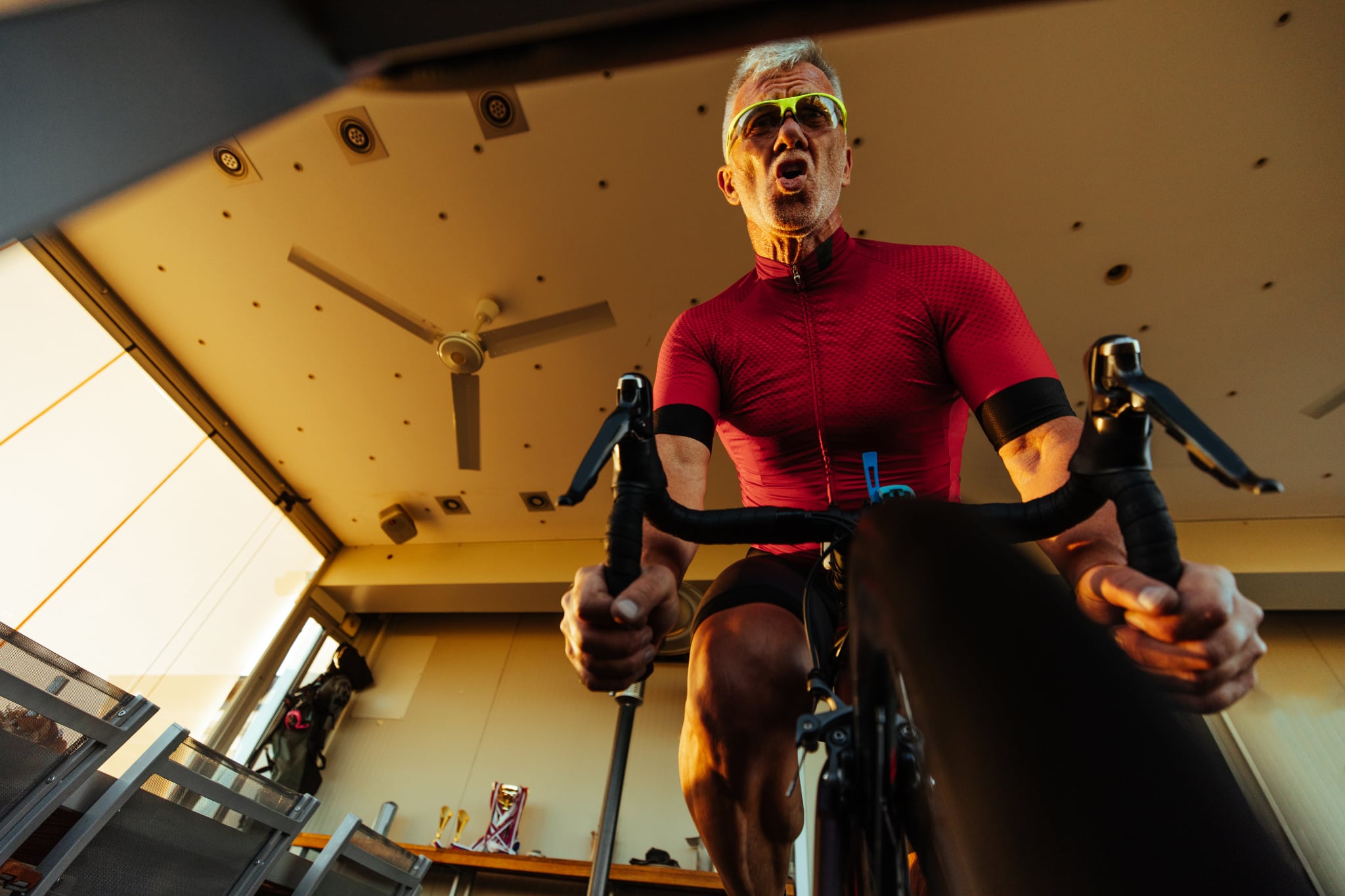
You ride a calibrated ergometer (ideally an electromagnetically braked trainer or an SRM/Cyclus2 unit) while wearing a mask connected to a metabolic cart. The cart measures the volume of air you breathe and the oxygen and carbon dioxide concentrations of every breath, calculating oxygen uptake breath-by-breath. The protocol is incremental: you start at an easy power — say 100 watts — and the resistance steps up at fixed intervals until you can no longer continue.
There are two common protocol structures. A step (graded) protocol raises power in discrete jumps, for example 25–30 watts every 1–3 minutes, which is useful when the lab also wants to sample blood lactate at each stage. A ramp protocol increases power continuously and smoothly, often 20–30 watts per minute, which tends to produce a cleaner VO2 plateau and a slightly higher peak. For pure VO2 max determination I prefer a ramp that brings the rider to exhaustion in 8 to 12 minutes. Shorter than 8 minutes and you risk being limited by local muscular fatigue before the cardiovascular system maxes out; longer than 12 and accumulated fatigue, heat, and substrate depletion start to drag the number down.
How the Lab Confirms You Actually Reached VO2 Max
A real VO2 max test doesn't just record the highest number on the screen — it verifies you reached a genuine maximum. Technicians look for a cluster of secondary criteria, and you typically need to satisfy at least two or three:
- A plateau in oxygen uptake despite increasing power — VO2 rises by less than ~150 ml/min across the final workload increment. This is the classic textbook criterion, though many strongly motivated cyclists never show a clear plateau, which is why the others matter.
- Respiratory exchange ratio (RER) above 1.10 — the ratio of CO2 produced to O2 consumed. An RER over 1.10–1.15 signals you're buffering large amounts of lactate and relying heavily on anaerobic energy, a sign you're near the top.
- Heart rate within ~10 beats of age-predicted maximum, or a measured plateau in heart rate.
- Blood lactate above 8 mmol/L in the minutes after the test.
- A rating of perceived exertion of 19–20 on the 6–20 Borg scale — in other words, you have nothing left.
If you only hit one of these, the technician should report the value as VO2 peak rather than VO2 max — the highest oxygen uptake observed, but not necessarily your true physiological ceiling. This distinction between peak and max is glossed over constantly in consumer testing, and it matters when you're comparing results over time. It's worth knowing that the plateau criterion itself is less reliable than it sounds — research on road and mountain-bike cyclists shows the apparent VO2 plateau depends heavily on how the gas-exchange data is averaged, so good labs lean on the full cluster of criteria rather than any single one (see this incremental-test study in young cyclists).
What a Lab Test Costs and Whether It's Worth It
Expect to pay somewhere between $100 and $300 for a cycling-specific CPET at a university lab, sports clinic, or performance centre, sometimes bundled with a lactate profile. For a serious cyclist building a season around objective data, it's money well spent once or twice a year — ideally one test at the start of base training and one after your main build, so you can see the adaptation. If you're going to invest, insist on a cycling ergometer (not a treadmill), a documented protocol, and a report that includes the verification criteria above, your maximal aerobic power (the wattage at VO2 max), and ideally your ventilatory or lactate thresholds expressed as a percentage of VO2 max. Those threshold-relative numbers are where the actionable coaching lives.
How to Test Your VO2 Max at Home (Field Tests)
Most cyclists will never set foot in a metabolic lab, and that's fine — you can get a usable estimate from a well-executed field test. You won't measure oxygen directly, but because maximal aerobic power and VO2 max are tightly linked, a maximal effort of the right duration lets you estimate VO2 max with reasonable confidence and, more importantly, track change over time.
The 5-Minute Maximal Test
The cleanest field proxy for VO2 max is your best 5-minute power, because a maximal 5-minute effort is run almost entirely at or very near VO2 max. Here's the protocol I give athletes:
- Warm up thoroughly for 15–20 minutes, including two or three short 30-second openers to wake up the aerobic system.
- On a steady climb of 4–6% gradient or an indoor trainer in ERG-off (resistance) mode, ride a flat-out, evenly paced 5 minutes. Pace it like a hard time trial — slightly conservative for the first minute, then build so you finish completely empty.
- Record your average power and your peak heart rate.
To convert 5-minute power to an estimated VO2 max, a workable approximation is: estimated VO2 max (ml/kg/min) ≈ (5-min power in watts ÷ body mass in kg) × 10.8 + 7. So a 70 kg rider holding 350 watts (5.0 W/kg) for five minutes estimates to roughly 61 ml/kg/min. Treat this as a ballpark — equations like this carry an error of several ml/kg/min — but the consistency of the method makes it excellent for tracking. Retest every 6–8 weeks under identical conditions and the direction of change is what you act on.
The Ramp Test
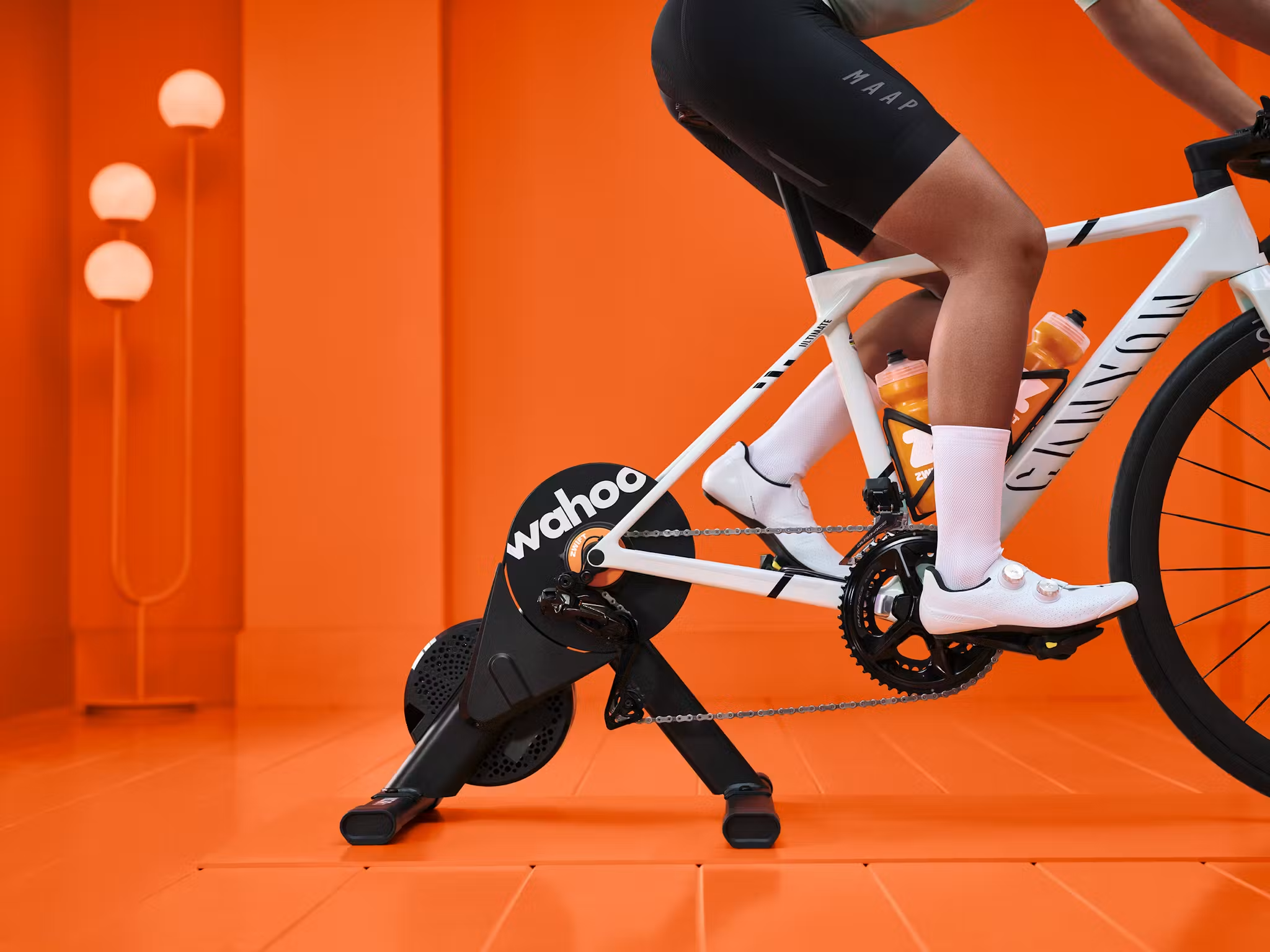
If you train indoors on a smart trainer, a ramp test is the most repeatable field option. Power increases by a fixed amount each minute (commonly 20–25 watts) until you can't hold the target. The final completed stage gives your maximal aerobic power, which maps closely to the wattage you'd produce at VO2 max in a lab. The ramp test's great virtue is reproducibility: the same warm-up, same trainer, same room temperature, and you'll get a number you can trust to compare month over month. Many indoor platforms automate this and will estimate FTP from it as well.
Garmin, Wahoo, and Wrist-Based VO2 Max Estimates
Your head unit or watch probably already shows a VO2 max figure. These come from algorithms — Firstbeat Analytics in Garmin's case — that model the relationship between your power (or pace) and heart rate during normal rides. They're genuinely useful for trend-spotting and they're free, but understand their limits: they assume an accurate max heart rate, they're sensitive to heat, fatigue, and poor heart-rate data, and they typically lag real change by a couple of weeks. Use them as a moving average, not as a precise verdict. If your Garmin says 58 in January and 62 in April after a structured block, that's a meaningful signal. If it bounces by two points between rides, that's noise.
VO2 Max Benchmarks: What's a Good Score?
Numbers only mean something in context, so here's how the values stack up across the cycling population. These are relative VO2 max figures in ml/kg/min, which is the metric that matters most for cycling because we fight gravity:
- Untrained adult male: roughly 35–45 ml/kg/min; untrained adult female roughly 27–37.
- Recreational/club cyclist: 45–55 for men, 40–48 for women.
- Strong amateur / Cat 1–2 racer: 58–68.
- Domestic elite / Continental pro: 65–75.
- WorldTour professional: 75–85+, with the very best Grand Tour climbers reported in the high 80s. Miguel Indurain was famously measured around 88, and modern GC riders are reported in a similar range.
A few things to keep in mind reading those bands. VO2 max declines with age — expect a drop of roughly 1% per year from your thirties onward unless you train hard to defend it. Women's values run lower than men's at the same training status largely because of differences in haemoglobin concentration and body composition, not because of any difference in trainability. And a high VO2 max is necessary but not sufficient: efficiency (how many watts you produce per litre of oxygen) and fractional utilisation (the percentage of VO2 max you can hold at threshold) separate riders who share the same ceiling. I've coached riders with a "lower" VO2 max who beat higher-tested rivals because they could ride at 88% of max for an hour while their rivals faded at 80%.
How to Use Your VO2 Max Result to Train Smarter
A test result you don't act on is just trivia. The whole point of measuring your aerobic capacity is to find out which lever to pull. Broadly, you're either trying to raise the ceiling (VO2 max itself) or raise the fraction of it you can sustain (threshold and efficiency). Most riders need both, sequenced correctly across a season.
Raising the Ceiling: VO2 Max Intervals
The most potent stimulus for VO2 max is time spent at or very close to it. The classic prescription is intervals of 3 to 5 minutes at 106–120% of FTP, with recoveries roughly equal to or slightly shorter than the work interval, accumulating 12 to 25 minutes of total work in the zone. A staple session I use:
- 5 × 4 minutes at the hardest power you can hold for all five reps (typically 110–115% FTP), with 4 minutes easy between. If you can't complete the last rep at target, you started too hard — the goal is maximum sustainable, evenly paced.
- Progression option: "30/15s" — 30 seconds hard, 15 seconds easy, repeated for 9–13 minutes per block. These let you accumulate more total time at high VO2 with lower perceived strain, and they're brilliant for riders who blow up on continuous 4-minute efforts.
Two or three of these sessions per week during a focused 4-to-6-week block produces the biggest VO2 gains, but they're costly — never stack them on consecutive days, and always anchor them on a deep aerobic base. Set your interval targets precisely using your current numbers; our FTP calculator and power zones calculator will give you the exact wattage bands to ride.
Building the Base That Makes Intervals Work
Here's what gets missed: VO2 max intervals work because of the aerobic base underneath them. The central adaptations that raise VO2 max — increased plasma volume, greater stroke volume, capillary density — are driven heavily by high volumes of lower-intensity riding. Zone 2 endurance work expands the very machinery that the high-intensity sessions then sharpen. If your VO2 max has plateaued despite hard intervals, the answer is almost always more easy volume, not more intervals. Pair your sessions to the right intensity by heart rate using our heart rate training zones calculator, and keep the easy days genuinely easy.
Turning the Engine Into Race Performance
Once the ceiling is raised, threshold and tempo work teaches your body to use more of it. A rider who lifts VO2 max but never trains fractional utilisation leaves watts on the table. The practical sequence across a season: build aerobic volume, then a VO2 block to lift the ceiling, then a threshold-focused block to raise the sustainable fraction, then race-specific work. Structuring that progression is exactly what a coach is for — if you want it periodised around your own test data and goals, you can apply for coaching or start with a tailored training plan built around your numbers.
What Limits Your VO2 Max — and What You Can Actually Change
Understanding why your number is what it is tells you how much room you have to improve it. Go back to the Fick equation: VO2 max is cardiac output multiplied by the oxygen your muscles extract. For the vast majority of healthy cyclists, the limiting factor sits on the delivery side — specifically maximal cardiac output, which is your maximal heart rate multiplied by stroke volume. This is the central conclusion of the most-cited review on the topic: oxygen delivery, not muscular extraction, is the primary ceiling on VO2 max in exercising humans (Bassett & Howley, 2000). Your max heart rate is essentially fixed and declines slowly with age; you can't train it up. Stroke volume, however — the amount of blood your heart ejects per beat — is highly trainable, and it's the single biggest reason endurance athletes have such large VO2 max values. Years of aerobic training enlarge the left ventricle and improve its filling, so each beat moves more oxygen-carrying blood.
Blood itself is the other major delivery lever. Total haemoglobin mass determines how much oxygen each litre of blood can carry, and plasma volume expansion — one of the fastest adaptations to endurance training, appearing within days to weeks — increases the volume your heart has to pump. This is also why training at altitude, or simply training consistently at high volume, lifts VO2 max: you're manufacturing more of the oxygen-carrying machinery. On the extraction side, capillary density and mitochondrial volume in the muscle determine how much of the delivered oxygen actually gets used. These respond strongly to both high-volume base riding and to VO2 intervals.
The practical takeaway is encouraging. A largely untrained rider can realistically improve VO2 max by 15–25% with structured training over months, with the fastest gains early as plasma volume and stroke volume respond. An already well-trained cyclist has a smaller ceiling for change — perhaps a few percent — but those few percent are often the difference between hanging on and getting dropped. What you genetically inherited sets the broad range; how you train decides where in that range you land, and most amateurs are nowhere near their own ceiling.
VO2 Max Test FAQ
Can I improve my VO2 max after 40?
Yes. The age-related decline of roughly 1% per year is an average for the general population, and it's driven as much by reduced training as by biology. Masters cyclists who maintain hard interval work and high aerobic volume hold onto far more of their VO2 max than sedentary peers, and previously untrained 40- and 50-year-olds routinely make large gains when they start structured training. Age changes the slope, not your ability to climb it.
Is a higher VO2 max always faster?
No — and this is the most important caveat in the whole topic. VO2 max sets the size of your engine, but races are won on sustainable power, efficiency, tactics, and durability. A rider with a 65 ml/kg/min ceiling who holds 90% of it at threshold will beat a 72 ml/kg/min rider who fades at 80%. Use VO2 max as one input alongside your FTP and threshold data, never in isolation.
How long does it take to raise VO2 max?
The earliest contributors — plasma volume expansion — move within one to two weeks. Meaningful, measurable change in the number itself typically takes a focused 4-to-8-week block combining VO2 intervals with adequate aerobic volume. That's why retesting every 6–8 weeks aligns well with how the physiology actually adapts.
Lab test or field test — which should I do?
If you can afford a lab CPET once or twice a year, do it for the absolute number and the threshold-relative data. For everything in between, a disciplined field test is more than adequate to track whether your training is working. The best setup is both: a lab anchor point, with regular field tests filling in the trend between.
Common VO2 Max Testing Mistakes
The fastest way to get a useless result is to test badly. The errors I see most often:
- Testing fatigued. A VO2 max or 5-minute test on tired legs underreads your true capacity. Come in rested — at least one easy or off day beforehand.
- Inconsistent conditions. Heat, dehydration, altitude, a different trainer, or even a noisy hot room can swing results by several percent. If you're tracking change, lock the conditions down: same trainer, same fan, same time of day, same warm-up.
- Pacing it wrong. Going out too hard on a 5-minute test wrecks the second half and undersells your aerobic power. Even pacing, finishing empty, is the skill.
- Trusting a single wrist-based number. One reading from a watch is noise. The trend over weeks is signal.
- Comparing peak to max. A VO2 peak from a short or unverified test isn't comparable to a true VO2 max. Know which one you got.
How Often Should You Test?
For lab testing, twice a year is plenty for most cyclists: once entering structured training to set your baseline and targets, and once after your main build block to confirm the adaptation worked. Testing more often than that rarely tells you anything a good field test wouldn't. For field tests — the 5-minute or ramp — every 6 to 8 weeks fits neatly with a typical training block, giving you a checkpoint at the end of each phase without testing so often that day-to-day variation drowns out the real trend. Always retest under matched conditions, and always log the context (sleep, fatigue, temperature) so you can interpret an off result rather than panic about it.
The Bottom Line on VO2 Max Testing
Your VO2 max is the size of your aerobic engine, and a properly run VO2 max test is the most direct way to measure it. Get it done right — a cycling-specific ramp to exhaustion with verification criteria in a lab, or a disciplined, repeatable 5-minute or ramp test in the field — and you'll have a number you can actually train against. But remember the hierarchy: the test is only valuable because of what you do next. Raise the ceiling with focused VO2 intervals, build the base that makes them work, then teach your body to use more of that ceiling at threshold.
If you want that whole process built around your own test data — your VO2 max, your thresholds, your race calendar — rather than guesswork, that's precisely what we do. Apply for coaching and we'll turn your numbers into a plan that makes them better.