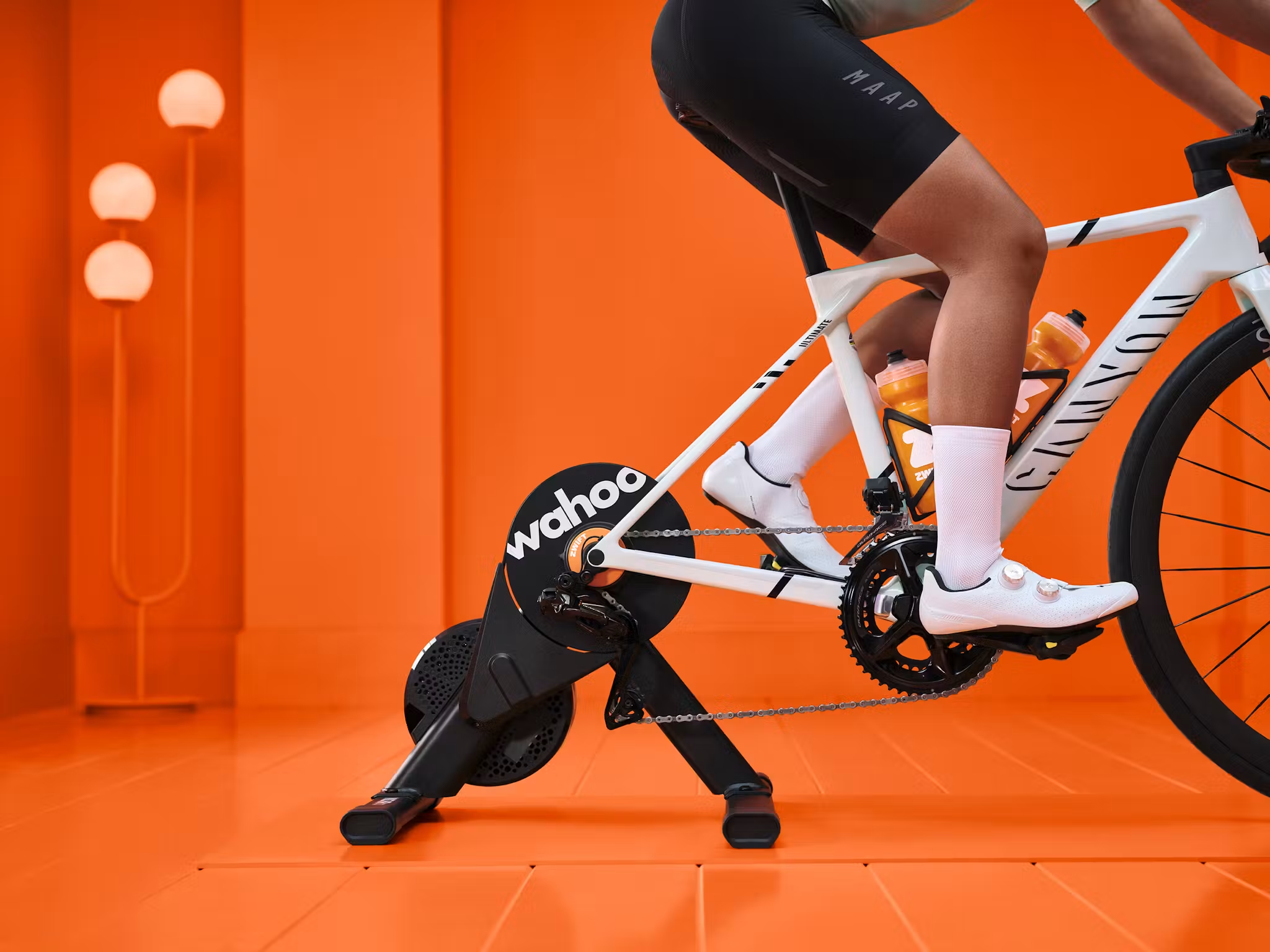
Few tools have changed how cyclists train as profoundly as the smart trainer. Done right, indoor cycling workouts deliver more measurable fitness per hour than almost anything you can do on the road, because every second is controlled. No coasting down descents, no stopping at intersections, no traffic dictating your effort. The trainer holds you to the exact wattage the session demands, and that precision is where adaptation comes from. I have coached riders who made bigger gains over a single rainy winter on the trainer than they did across an entire outdoor summer, simply because the indoor sessions were structured and the outdoor rides were not.
The catch is that a trainer rewards intent. Spin aimlessly for an hour while a show plays and you will get bored, sore, and slow. Follow a session built around your physiology and you will get faster. This guide gives you five complete indoor cycling workouts I use with the athletes I coach, the science behind why each one works, and a framework for slotting them into a real training week. Every workout is anchored to your FTP and your training zones, so the first job is to make sure those numbers are dialed in.
Why Indoor Cycling Workouts Build Fitness Faster
The advantage of the trainer comes down to a single word: specificity. Physiological adaptation is driven by the dose of stress you deliver to a system, and on the road that dose is constantly contaminated. You set out to ride at threshold and a headwind, a climb, or a red light pushes you above or below it within seconds. Indoors, especially in ERG mode where the trainer adjusts resistance to hold a target power regardless of cadence, you can spend twenty unbroken minutes at exactly the intensity that drives the adaptation you want.
That control matters because the dose-response curve for cycling fitness is narrow. Research on interval training has repeatedly shown that time spent in the correct intensity band, not total volume, is the primary driver of improvements in VO2 max and lactate threshold. A frequently cited body of work from groups like Stephen Seiler's has demonstrated that well-structured interval sessions produce disproportionate gains relative to the time invested. The trainer is simply the most reliable way to hit that band and stay in it.
There is also a time argument that every working adult understands. A focused 60-minute indoor session with a proper warm-up, a hard main set, and a cooldown can deliver the same training stimulus as a two-and-a-half hour outdoor ride, because none of the time is wasted on soft pedaling. For anyone training around a job and a family, that efficiency is the difference between consistency and burnout. The trainer also removes every excuse: weather, daylight, road safety, and route planning all disappear.
One more underrated benefit is data quality. Because power, cadence, and heart rate are recorded in a stable environment, your indoor files are clean enough to actually analyze. You can see whether your power held steady across a set of intervals or faded, whether your heart rate decoupled from your power, and whether you are recovering between efforts. That feedback loop is how training stops being guesswork and starts being engineering.
Set Up Your Zones Before Your First Session
Every workout below is prescribed as a percentage of your Functional Threshold Power, the highest average power you can sustain for roughly an hour. If you do not have a current FTP, the workouts have no anchor and you will either ride too easy to adapt or too hard to complete the set. Test it first. You can use a 20-minute field test (take 95 percent of your 20-minute average) or a ramp test, then plug the result into our FTP Calculator to confirm the number and set your training zones.
From FTP you can derive your power zones, which is how the main sets in this guide are described. Our Power Zones Calculator will break your FTP into the standard seven-zone model so you know exactly what 88 to 94 percent of threshold or 110 to 120 percent of threshold feels like in watts. If you train without a power meter and rely on heart rate, run your numbers through the Heart Rate Zones Calculator instead, but understand that heart rate lags effort by 30 to 60 seconds, which makes it a poor guide for the shortest, hardest intervals. For VO2 and sprint work, power or perceived exertion will serve you far better than chasing a heart rate number that arrives too late.
A few practical setup notes that separate productive indoor cycling workouts from miserable ones. Put a fan in front of you, ideally two. You cannot cool yourself indoors the way moving air does outside, and a rider who overheats produces less power and ends the session early. Have a towel and at least one full bottle within reach for every hour you plan to ride. Calibrate your trainer after it has warmed up for ten minutes so the power numbers you are chasing are honest. And decide before you start whether you will run ERG mode, which forces you to hold the target, or standard mode, which leaves the resistance to you and demands more self-discipline.
The 5 Indoor Cycling Workouts

These five sessions cover the full range of energy systems a complete cyclist needs to develop: aerobic endurance, sustainable threshold power, the sweet spot that builds the most fitness per unit of fatigue, VO2 max, and anaerobic sprint capacity. Rotate through them across a week and you train every gear. Each one includes a warm-up, the main set, and a cooldown, with the total session time noted. Adjust the number of intervals up or down based on your current fitness, but keep the target intensities honest.
Workout 1: Sweet Spot Builder (60 minutes)
Sweet spot training sits at 88 to 94 percent of FTP, just below threshold. It is the most valuable real estate in endurance cycling because it delivers a large aerobic and muscular stimulus while generating far less fatigue than all-out threshold work, which means you can do more of it and recover faster. This is the bread-and-butter session for building a bigger engine through the base and early build phases.
The session:
- Warm-up: 12 minutes building from easy spinning (Zone 1) to the top of Zone 2, with two 30-second efforts at 100 percent FTP in the final three minutes to open the legs.
- Main set: 3 x 10 minutes at 90 percent FTP, with 5 minutes of easy Zone 1 recovery between intervals.
- Cooldown: 8 minutes of easy spinning, dropping cadence and power progressively.
Hold your cadence between 90 and 95 rpm and keep your upper body quiet. The effort should feel like controlled, rhythmic pressure, never a fight. If you finish the third interval and feel you had a fourth in you, you held it correctly. As you adapt, progress this by extending the intervals to 3 x 12 or 3 x 15 minutes before you add a fourth block. Sweet spot is where consistency compounds: ride it twice a week for six weeks and your FTP will move.
Workout 2: VO2 Max 30/15s (50 minutes)
VO2 max is the ceiling on your aerobic engine, the maximum rate at which your body can use oxygen, and it is highly trainable with short, hard intervals performed above threshold. The 30/15 format, popularized by research into microintervals, lets you accumulate far more time at or near VO2 max than longer 3-to-5-minute efforts, because the brief 15-second recoveries keep oxygen uptake elevated while letting you reset enough to repeat the effort with quality.
The session:
- Warm-up: 15 minutes progressive, finishing with three 1-minute efforts at 105 percent FTP to prime the cardiovascular system.
- Main set: 2 sets of 9 x (30 seconds at 115 to 120 percent FTP, 15 seconds easy spinning). Take 5 minutes of easy recovery between the two sets.
- Cooldown: 8 minutes easy.
The first few reps will feel deceptively manageable. By the sixth they should be genuinely hard, and the final two of each set should require real focus to hold the target. If you are fading badly before the end, your interval power is set too high. This is one of the few sessions where I strongly prefer standard mode over ERG, because the 30-second on, 15-second off rhythm is too quick for most trainers to track smoothly in ERG. Shift to a harder gear, hit the watts, then back off. For the science of why short intervals are so effective, the work on VO2 max development is worth reading directly (see this PubMed review on interval training).
Workout 3: Threshold Over-Unders (65 minutes)
Over-unders teach your body to clear lactate while you keep working, which is the single most race-relevant skill for any cyclist who climbs, time trials, or covers attacks. By alternating efforts just below threshold with surges just above it, you train your muscles to buffer and reuse the metabolic byproducts that would otherwise force you to slow down. This is how you turn a fragile FTP into a durable one that survives repeated accelerations.
The session:
- Warm-up: 12 minutes building, with two 1-minute efforts at threshold near the end.
- Main set: 3 x 9 minutes structured as alternating 2 minutes at 95 percent FTP (the under) and 1 minute at 105 percent FTP (the over), repeated three times within each 9-minute block. Recover 5 minutes easy between blocks.
- Cooldown: 8 minutes easy.
The trap here is going too hard on the over portions and blowing up. The overs are surges, not sprints. The whole point is that the under segments feel like recovery even though you are still working at 95 percent of threshold, which only happens if your lactate-clearing machinery is working. The first block will feel reasonable, the second will burn, and the third is where the adaptation lives. If you can only complete two blocks cleanly the first time, that is your honest starting point. Build to three.
Workout 4: Sprint and Anaerobic Capacity (55 minutes)
Most endurance cyclists neglect the top end entirely, and it costs them races. Anaerobic capacity is what powers the decisive attack, the bridge to a break, and the final 200 meters. These efforts are short and maximal, drawing on the glycolytic system, and they need long recoveries so each rep is genuinely high quality rather than a fatigued imitation of a sprint.
The session:
- Warm-up: 15 minutes thorough, including three 10-second build-up sprints at increasing intensity to recruit fast-twitch fibers safely.
- Main set A: 5 x 30 seconds all-out (aim for 150 percent of FTP or higher), with 4 minutes of easy spinning between each.
- Main set B: after 5 minutes easy, 6 x 15-second maximal sprints from a rolling start at around 80 rpm, with 3 minutes recovery between each.
- Cooldown: 8 minutes easy.
Do not skimp on the recovery intervals. The goal is power, not lactate tolerance, so each effort should be as close to maximal as the last. On the trainer, sprints feel different than on the road because there is no forward momentum and the resistance can spike abruptly; stay seated for the 30-second efforts and you can rise out of the saddle for the 15-second sprints if your trainer and frame are stable. If your peak power on the sixth sprint has dropped more than about 10 percent from the first, you have done enough; chasing more reps just trains fatigue.
Workout 5: Zone 2 Endurance (90 minutes)
Not every indoor session should hurt. Zone 2, roughly 56 to 75 percent of FTP, is where you build aerobic base, mitochondrial density, and fat-burning efficiency, and it is the foundation every harder session is built on. The trainer makes Zone 2 work surprisingly efficient because you never coast, so an indoor endurance ride accumulates more genuine aerobic time than the equivalent duration outside. This is the session that quietly raises your FTP by lifting the floor underneath it.
The session:
- Warm-up: 10 minutes easing into Zone 2.
- Main set: 70 minutes steady at 65 to 70 percent FTP. Every 15 minutes, insert a 1-minute high-cadence block at 100 to 105 rpm (same power) to work on pedaling efficiency and keep the mind engaged.
- Cooldown: 10 minutes easy.
The discipline here is staying in the zone. The temptation indoors is to let the power drift up because steady riding feels too easy, but creeping into Zone 3 turns a recovery-friendly aerobic ride into a fatiguing one that compromises your hard days. Keep it conversational. If you can comfortably hold a conversation, you are in the right place. For riders short on time, 60 minutes still delivers most of the benefit; the 90-minute version is for when you want to build genuine endurance through the base phase. To understand how much of this riding you should be doing, our deeper look at zone 2 training in the series is worth a read once it publishes.
How to Fit These Indoor Cycling Workouts Into Your Week
Five workouts do not mean five sessions every week. The art of training is arranging stress and recovery so adaptation actually happens. For most time-crunched riders training three to four times a week, a productive structure pairs hard days with genuinely easy days and never stacks two high-intensity sessions back to back.
A strong four-day template through a build phase looks like this. Monday is rest or full recovery. Tuesday is a hard quality session, alternating weekly between the VO2 30/15s and the threshold over-unders. Wednesday is the Zone 2 endurance ride or rest. Thursday is the sweet spot builder. Friday is rest or easy spinning. Saturday is your longest ride, indoors or out, and Sunday is endurance or recovery. The sprint and anaerobic session slots in during the weeks you are sharpening for an event, replacing one of the threshold days.
The principle underneath the template matters more than the template itself: roughly 80 percent of your weekly training time should be easy, and only about 20 percent should be in the hard intensity bands. This polarized distribution is one of the most robust findings in endurance science, and it is the structure used by the majority of elite endurance athletes. Most amateurs invert it, riding their easy days too hard and their hard days not hard enough, and they plateau. If you take one organizing idea from this guide, make it that one. If you would rather have the whole week mapped out for you around your schedule and your goals, a tailored training plan removes the guesswork entirely.
Getting the Most From Every Trainer Session
The workout is only half the equation. How you execute it determines whether the prescribed stress actually lands. A few habits separate riders who improve indoors from those who just sweat.
Fuel the session properly. For anything over an hour, or for the high-intensity workouts regardless of length, take in 30 to 60 grams of carbohydrate per hour. Glycogen is the fuel for hard efforts, and riding the VO2 or threshold sessions depleted means you cannot hit the targets that drive adaptation. A bottle with mix and a gel within reach is enough for most sessions. Hydration is equally critical indoors because you sweat far more than outside; aim for at least 500 to 750 milliliters of fluid per hour, more in a hot room.
Mind your cadence deliberately. Each workout above specifies a cadence range for a reason. Sweet spot and threshold work at 90 to 95 rpm builds the aerobic efficiency you want, while the high-cadence blocks in the Zone 2 ride train neuromuscular smoothness. Grinding every session at a low cadence overloads the muscular system and underdevelops the cardiovascular one. Pay attention to it.
Use ERG mode wisely. For steady-state work like sweet spot, threshold, and Zone 2, ERG mode is a gift because it forces you to hold the target and removes the temptation to fade. For the shortest, sharpest efforts (the 30/15s and the sprints), switch to standard mode so the resistance responds instantly to your gearing rather than lagging. Knowing when to use which is a small detail that meaningfully improves session quality.
Finally, protect your environment. Two fans, a mat under the trainer, a sweat guard over the top tube, and a sealed bottle of cold water turn a grim experience into a tolerable one, which means you show up again tomorrow. Consistency is the real engine of improvement, and consistency is far easier when the session is not actively unpleasant.
Common Indoor Training Mistakes to Avoid
The same handful of errors undermine most riders' indoor cycling workouts. The first is riding everything at the same medium-hard intensity, the gray zone between easy and hard that feels productive but drives neither aerobic base nor top-end power. Make your easy rides genuinely easy and your hard rides genuinely hard.
The second is testing too rarely. Your FTP changes as you train, and a number from three months ago will have your sweet spot intervals landing in the wrong place. Retest every four to six weeks during a build phase so your zones stay accurate. The third is neglecting recovery, treating the trainer's convenience as license to ride hard every day. Adaptation happens during rest, not during the session, and the riders who improve fastest are usually the ones disciplined enough to take their easy days easy.
The fourth, and most common, is starting without a plan and improvising once the legs hurt. The structure is the point. Decide the session before you clip in, commit to the targets, and let the numbers, not your mood, dictate the effort.
Turn These Workouts Into Real Fitness
These five indoor cycling workouts give you a complete toolkit: a foundation of aerobic endurance, the sweet spot work that builds the most fitness per hour, the threshold sessions that make your FTP durable, and the VO2 and sprint efforts that sharpen your top end. Rotate through them with an 80/20 balance of easy to hard, keep your zones current, and respect your recovery, and you will be measurably faster within a couple of months, whatever the weather outside.
The difference between a generic plan and a great one is how well it fits your physiology, your schedule, and your goals. If you want every session sequenced around exactly where you are now and where you want to be, this is precisely what we do for the riders we coach. Apply for coaching and we will build your training around the engine you are trying to develop, or start with a structured tailored training plan and put these workouts to work this week.